The 2026 CFO AI Stack: What Finance Teams Are Actually Buying


Fifty-one percent of VC-backed CFOs now report measurable ROI from their AI spending. That's the headline I can't stop thinking about from Silicon Valley Bank's State of the VC-Backed CFO 2026 report, which surveyed 230 finance leaders at venture-backed companies. For years, the pitch for AI in finance sounded like a promise. In 2026 it sounds like a receipt.
This is my honest tour of the 2026 CFO AI stack, category by category, with the tools that matter and the data that grounds what's actually happening.
Why the CFO stack is being rebuilt right now
The numbers tell a clear story:
- AI is now the #1 external concern for VC-backed CFOs, above inflation, interest rates, tariffs, and regulation. 62% put it in their top two, up from 49% last year.
- Median AI spend at VC-backed startups went from $2,000 in 2024 to $20,000 in 2025, with $50,000 expected in 2026. A 25x jump in two years.
- Over 90% of these companies now encourage AI use at work, up from 68% the prior year.
- 35% of finance leaders say AI productivity gains have already led to fewer junior hires. Only 5% report AI-related layoffs. This is a hiring mix shift, not broad cuts.
- Companies that integrate AI into their products report more than double the median revenue growth of those that don't.
- Deloitte's Q4 2025 CFO Signals: 50% of CFOs say digital transformation of finance is their top 2026 priority. 54% rank AI agent integration as their #1 transformation initiative. 63% of finance departments actively use AI today.
- HBR/Return on AI Institute research: only 2% of C-suites assign AI value accountability to the CFO, but when they do, 76% report capturing "a great deal" of AI value, versus 53% for CIO/CTO-owned stacks.
That last stat is the arbitrage. The CFO is the highest-leverage owner of AI ROI, and almost nobody has put them in charge yet.
How to think about the 2026 stack
The stack isn't a list of apps. It's a pipeline. Cash moves from contracts through billing through collections through the ledger into forecasts. Every AI tool either speeds a step or connects two steps that used to be stitched together with spreadsheets.
The average 2026 CFO office now runs 6 to 9 AI-enabled tools, up from 3 to 4 in 2023, with 20 to 30% functional duplication and total cost typically 40 to 60% higher than license cost once integration is counted. That's the hidden tax on a stack assembled without intent.
FP&A
- Runway has become the default modern planning tool for venture-backed teams that want something that doesn't feel like Hyperion.
- Cube sits on top of existing spreadsheets rather than replacing them, which makes it disarmingly easy to adopt.
- Aleph is pushing deeper into AI-native modeling, connecting directly into ERPs and warehouses.
- Datarails, Planful, Vena, Abacum, and Jedox serve mid-market and upmarket teams, each with an Excel-first, workflow-first, or enterprise slant.
- Fuel Finance targets earlier-stage founders who need a fractional-CFO-in-a-box experience.
The winners will be the ones whose data models were designed for AI, not retrofitted.
Close management
- Numeric raised a $51M Series B led by IVP in November 2025, bringing total funding to $89M. Brex piloted Numeric's cash module and saw its match rate jump from 30% to over 90%. Customers include Wealthfront, OpenAI, and Plaid.
- Nominal tackles complex multi-entity accounting with an AI-native general ledger approach.
- Digits pushes AI into real-time books for smaller teams.
- Maximor, Maxima, Light, and Everest cover reconciliation automation and audit-ready workpaper drafting.
If you're still closing in spreadsheets, 2026 is the year to fix it.
Accounts payable and spend
AP AI adoption quadrupled to 29% in 2025, up from 7% in 2024.
- Ramp is the category-defining spend platform. Recent $500M round at a $22.5B valuation.
- Brex has repositioned into a full spend and treasury platform with AI embedded across receipts, expense coding, and bill approvals.
- Airbase (now part of Paylocity) pioneered the unified spend approach.
- Spendesk is strong in multi-entity European operations.
- Procurify is favored by mid-market teams needing deeper procurement workflow.
- Trovata focuses on bank-API-driven cash management and treasury forecasting.
Accounting and ERP
This is where the most capital is flowing and NetSuite is finally getting a credible challenge.
- Rillet raised a $70M Series B in August 2025 co-led by a16z and ICONIQ, ten weeks after a $25M Series A from Sequoia. 200+ customers including Bitwarden, Windsurf, and Postscript. Claims 93%+ of manual accounting functions automated.
- Campfire went from a $3.5M seed to a $65M Series B, over $100M raised in twelve weeks during fall 2025. Customers include PostHog, Decagon, Replit, and Klarity. One customer reports going from $10M to $200M ARR without growing the accounting team.
- DualEntry raised a $90M Series A at a $415M valuation in October 2025.
- Doss is the emerging option for physical operations where NetSuite has owned the market.
- Digits, Light, and Everest continue evolving toward AI-native accounting for smaller teams.
If you're picking an ERP in 2026 and don't evaluate at least one AI-native option alongside NetSuite or Intacct, you're not doing your job.
Invoicing and billing
This is the category I live in, and the one where AI most directly touches cash on hand.
Billing used to be solved. Usage-based pricing, hybrid models, credits, tiered commitments, and mid-term amendments made it unsolved again. The market data makes the stakes clear:
- The AR automation market is $3.4 to $4.3B in 2025, forecast to hit $6.6 to $10.1B by the early 2030s, growing 10 to 14% CAGR.
- A study of 500 companies using AI in AR found 82% reported productivity gains and almost all reduced DSO.
- Automated systems collect 12 to 18 days faster than manual processes.
- Per a JPMorgan working capital study, reducing DSO by just 7 days frees up cash equal to 2% of annual revenue. On $50M ARR, that's a million dollars of working capital you weren't using.
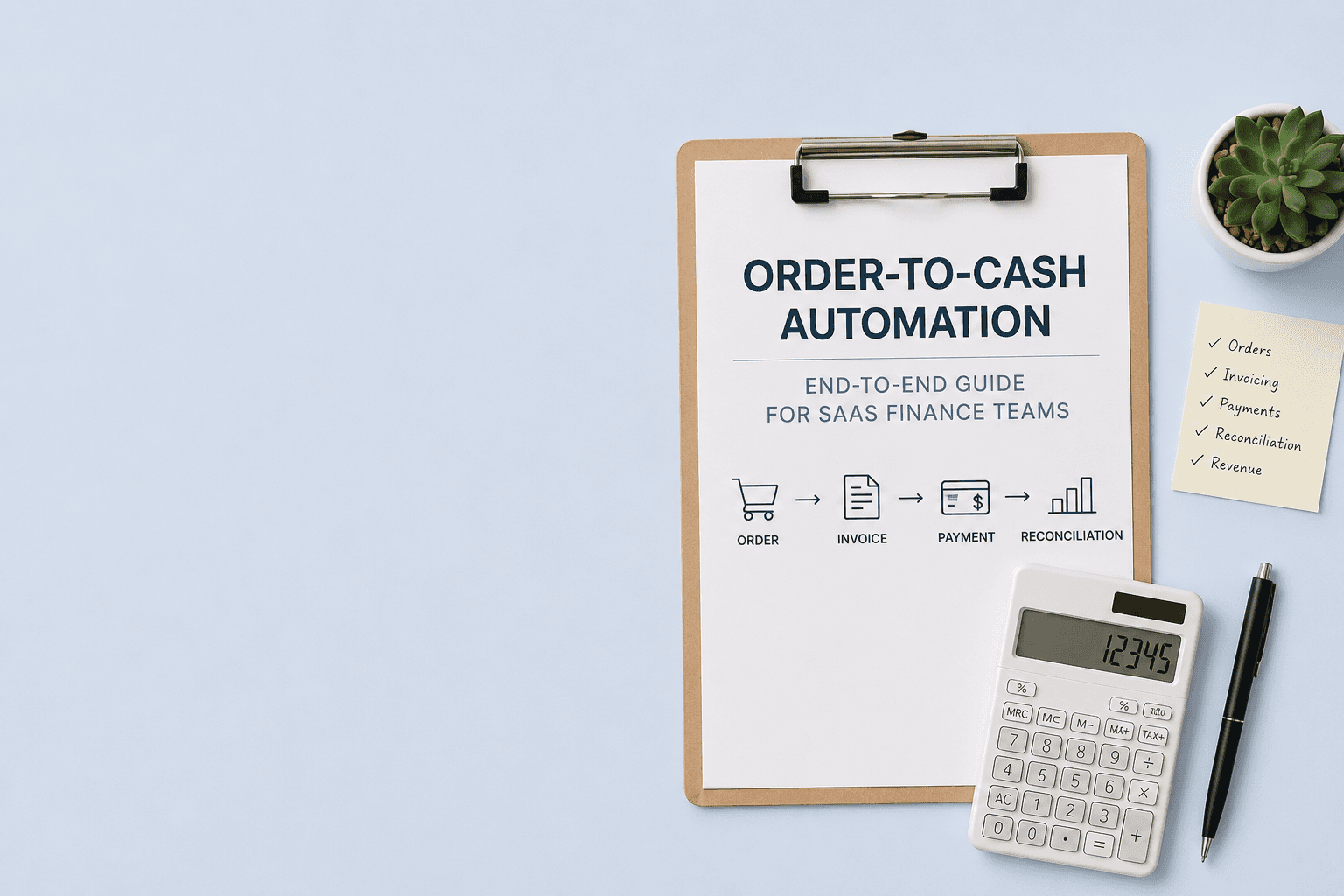
JustPaid is what we built to handle the full order-to-cash cycle in one platform. Here's why it belongs in the 2026 stack:
- AI contract ingestion. Fully executed contracts, including complex enterprise agreements on DocuSign, get parsed into dynamic revenue records automatically. No more rekeying terms into a billing system.
- Handles any pricing model. Subscriptions, usage-based, tiered, hybrid, credits, promotions, discounts, custom SLAs. Pricing changes every quarter and we're built for that reality.
- Auto-invoicing and reconciliation. Invoices generate on schedule, payments reconcile against open AR, exceptions route to humans only when the AI can't resolve them.
- Collections that sound human. Our Reminder AI picks the right channel (email, SMS, phone) and escalates tone and timing based on how a customer actually pays, not a fixed dunning schedule.
- Layers on your existing stack. We sit on top of Salesforce, HubSpot, Stripe, NetSuite, and QuickBooks, so finance teams keep their systems of record and add intelligence on top.
- Measured impact. Customers go from two-day month-end AR closes to about two hours.
What we do differently is treat invoicing, billing, and AR as one revenue operations problem that spans CRO and CFO, not three disconnected back-office chores.
Tax
- Numeral is the AI-native sales tax platform I'd put near the top of the list for any SaaS or e-commerce company today. Handles U.S. sales tax, VAT, and international compliance with automated nexus monitoring, registrations, and filings. Deep integrations across billing systems and e-commerce platforms, and processes meaningful transaction volume for modern brands.
- Anrok is the established sales tax automation tool widely adopted across SaaS.
- Taxwire and Sphere are newer AI-native plays on the same problem.
- Accordance is moving into AI-driven tax advisory workflows.
- April builds AI-native personal tax and embedded tax infrastructure.
The quiet category that will matter a lot more in 2027 than it does today.
Revenue recognition
- JustPaid handles rev rec as a natural extension of its order-to-cash platform. Because our AI already ingests the contract and tracks every billing event, revenue schedules build themselves and stay in sync with what's actually been delivered and paid.
- RightRev is the pure-play platform enterprise teams evaluate when NetSuite's native rev rec breaks down.
- Zenskar handles rev rec natively as part of its order-to-cash platform.
- Stripe has quietly built a credible rev rec engine on top of Stripe Billing covering standard SaaS cases.
Procurement
Software procurement is where finance teams waste the most money they don't know about.
- Vendr pioneered SaaS buying-as-a-service and evolved into a procurement platform with deep benchmark data.
- Tropic combines procurement workflow with negotiation leverage.
- Vertice is the fast-growing European entrant with strong procurement intelligence data.
Every one of these pays for itself on the first renewal they help you cut.
Connections
When you have six to nine AI tools across finance, the real question isn't which ones you bought. It's how they talk to each other. This is the category that gets talked about least and matters most.
- loopfour is what we built for finance-first automation, announced in April 2026. It sits on top of your stack and lets finance teams describe what they need in plain English and deploy it in minutes. AI agents understand invoice, receipt, and contract structures out of the box. Triggers include Slack messages, emoji reactions, emails, webhooks, and app events. Approvals route through Slack, email, or custom endpoints, so CFOs keep the controls they care about and remove the clicks they don't.
- n8n is the open-source workflow automation platform that engineering-heavy teams use when they want full control and self-hosted deployments. Strong for custom logic and technical integrations.
- Gumloop is the AI-native workflow builder non-technical teams reach for when they want to automate document processing, data enrichment, and multi-step AI chains without writing code.
- Zapier remains the default for simple trigger-action automations across thousands of apps.
- Make (formerly Integromat) offers visual multi-step scenarios with more logic than Zapier.
- Workato is the enterprise-grade iPaaS that shows up in larger finance orgs needing deep SAP, Oracle, and Workday integrations.
Pick a connections layer on purpose. It's the only way to avoid the 20 to 30% functional duplication Deloitte is tracking across mid-market finance stacks.
What to do with this in 2026
If I were a founder or CFO planning the next 18 months:
- Assume your AI budget will roughly double. If you're under-spending, you're probably under-automating.
- Anchor on ROI per function, not tools per function. Lean into billing, close, and AP first. That's where finance ROI is most measurable.
- Give someone accountability for AI value inside finance. That 76% value-capture rate when CFOs own AI is the cleanest arbitrage in the SVB data.
- Plan for a connections layer from day one. The cost of an unconnected stack is hidden, but real.
- Stop treating billing and AR as a back-office problem. Seven days of DSO is 2% of revenue in working capital. That's a Series A round's worth of cash sitting in customer inboxes.
The tools are here. The ROI is real. The SVB report's numbers say that clearly, and so do our customers. The question is whether you're going to build the stack on purpose or let it accumulate by accident.
If you're working on the billing and AR side of it, I'd love to talk. You can see what JustPaid does and book time with our team.
The CFO used to be the person who said no. In 2026, the CFO is the person who says yes faster than anyone else in the company, because they have the data, the tools, and the agents to back it up. That's the stack worth building.
Get Started with JustPaid
Automate invoicing, streamline accounts receivable, and accelerate revenue with JustPaid. Compare JustPaid pricing plans or book a walkthrough.