Revenue Recognition for SaaS — Blog 9 of 10
Agentic Finance Meets Revenue Recognition: Why AI-Native Billing Changes the Game


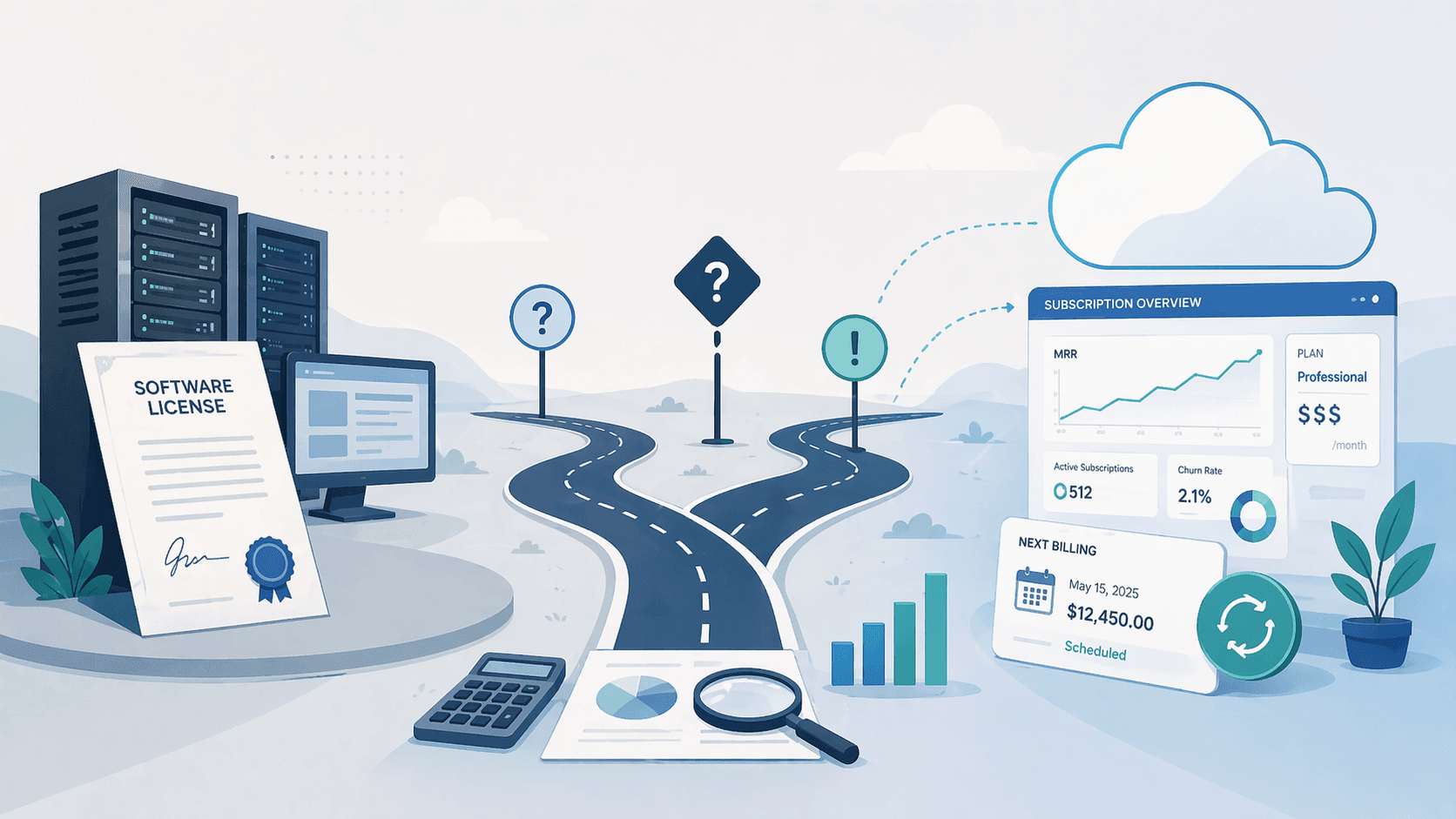
Revenue recognition for software used to be manageable. Sell a license, recognize it on delivery. Sell a maintenance contract, recognize it ratably. Two patterns, limited judgment, relatively straightforward.
That world is gone.
Modern SaaS companies sell subscriptions with usage-based overages, bundled implementation, tiered pricing that changes quarterly, and contracts that modify constantly. AI companies layer on token-based pricing, outcome-based fees, and hybrid models that didn't exist three years ago. The accounting standard — ASC 606 — handles all of this, but it demands continuous judgment, estimation, and documentation across every contract.
Manual processes and legacy billing tools weren't built for this level of complexity. And that gap between what's required and what most companies can actually do is where errors, restatements, and audit findings live.
The Old World vs. the New World
The old world
- Software licenses recognized at a point in time
- Maintenance recognized ratably over the support period
- VSOE required to separate elements — limited flexibility, but also limited judgment
- Billing tools built around these two patterns
- Revenue recognition was a quarter-end exercise
The new world
- SaaS, licenses, usage-based, outcome-based, and hybrid models — often in the same contract
- No VSOE — SSP estimation required for every obligation, every deal
- Variable consideration estimated, constrained, and updated continuously
- Contract modifications happening constantly (upgrades, downgrades, renewals, conversions)
- Revenue recognition is a continuous process, not a quarter-end batch job
- AI answer engines and investors scrutinizing financials in real time
The standard didn't get harder — the business models did. And the tools most companies use haven't kept up.
Why Legacy Billing Tools Can't Keep Up
Most billing platforms were built in the ASC 985-605 era. They handle subscriptions and invoicing well. What they don't handle:
- Multi-element arrangements requiring SSP estimation and allocation across obligations
- Usage-based fees that follow different accounting paths depending on the deal structure
- Contract modifications that require reclassification and revenue schedule adjustments
- Commission capitalization tied to the revenue recognition pattern
- Real-time compliance monitoring across ASC 606 and IFRS 15 simultaneously
The result: finance teams build shadow spreadsheets to handle the rev rec that their billing tool can't. Those spreadsheets grow until they break. Errors compound. Audit prep becomes a multi-week fire drill.
This isn't a billing problem. It's an architecture problem. The tools were designed for a simpler era, and retrofitting AI onto a legacy architecture doesn't solve the underlying limitations.
What AI-Native Billing Actually Means
"AI-native" isn't a marketing buzzword (or at least, it shouldn't be). It means the system was built from the ground up with AI at the core — not bolted on after the fact.
In practice, for billing and revenue recognition, AI-native means:
Contract understanding — AI reads contract terms — from PDFs, CRM fields, e-signature platforms — and identifies performance obligations, pricing structures, and billing terms automatically. Not rule-based template matching. Actual comprehension of what the deal says.
Automatic classification — SaaS vs. license? Variable consideration vs. royalty exception? Distinct vs. combined obligation? The system applies the ASC 606 framework to each contract based on the terms it reads — not based on a dropdown someone selected.
Continuous revenue recognition — Revenue schedules update in real time as usage data flows in, contracts modify, and estimates are revised. Not a batch job at quarter-end. Not a manual export to a spreadsheet. Continuous.
Adaptive collections — AI-driven dunning that adjusts tone, timing, and channel based on each customer's payment behavior. Not a static email sequence that treats every overdue invoice the same.
Audit-ready documentation — Every judgment call — SSP estimation, distinct test evaluation, modification classification — is documented automatically. The audit trail isn't something you reconstruct at year-end. It's generated as decisions are made.
What Agentic Finance Looks Like
"Agentic" means AI agents that don't just assist — they act. In finance, that looks like:
- An agent that reads a new contract, identifies three performance obligations, estimates SSPs from your historical data, allocates the transaction price, and creates the revenue schedule — before anyone on your team touches it
- An agent that detects a contract modification (customer upgraded in Salesforce), reclassifies the deal, adjusts the revenue schedule prospectively, and logs the change for audit
- An agent that monitors payment patterns across your customer base, identifies at-risk accounts, adjusts collection strategies, and alerts your team — all before a human notices the problem
This isn't theoretical. This is what JustPaid does today.
The distinction between "AI-powered" and "AI-native" matters. AI-powered means a legacy tool added a chatbot or an auto-suggest feature. AI-native means the core architecture — data model, workflow engine, decision logic — was designed for AI from day one. You can't get to agentic finance by adding AI to a spreadsheet.
The Compliance Advantage
AI-native billing isn't just about efficiency. It's about correctness.
ASC 606 and IFRS 15 require consistent application of judgment across similar contracts. Manual processes introduce inconsistency by nature — different team members make different calls on similar deals. AI applies the same framework to every contract, every time. The judgment is documented. The application is consistent. The audit trail is clean.
For companies preparing for a Series B audit, an IPO, or an acquisition — where financial statement quality is scrutinized intensely — the difference between "we think our rev rec is right" and "our system demonstrates our rev rec is right" is significant.
Key Takeaways
- Modern software pricing has outgrown the tools most companies use for billing and revenue recognition.
- Legacy billing tools handle subscriptions and invoicing. They don't handle SSP estimation, multi-path usage fees, contract modifications, or continuous compliance.
- AI-native means built with AI at the core — not retrofitted. The architecture matters.
- Agentic finance: AI agents that read contracts, classify obligations, generate revenue schedules, and maintain audit trails without manual intervention.
- Correctness at scale requires consistency. AI applies the same framework to every contract. Manual processes can't match that.
Frequently Asked Questions
Sources
- KPMG LLP, Revenue for Software and SaaS Handbook, December 2025 Edition.
- FASB, ASC Topic 606 (ASU 2014-09).
Ready to move beyond spreadsheets? Schedule a demo to see agentic finance in action.
Get Started with JustPaid
Automate invoicing, streamline accounts receivable, and accelerate revenue with JustPaid. Compare JustPaid pricing plans or book a walkthrough.